※ Non destructive
Generating damping within structures or machines with ADD is a non-invasive process. No structural modifications are required. ADD is simply fixed on the device and adds damping. If the control is closed, the behavior of the structure will be the same as the original behavior. After opening the control again, the structural behavior will remain unchanged, but resonance will be weakened.
※ Addition process
Using ADD damping is an additional process. In other words, the more ADD is attached to the structure or machine, the greater the damping obtained.
※ Control robustness
Due to the selected configuration of juxtaposed sensors and actuators, it can be demonstrated that a more robust and stable control scheme can be achieved, thus the stability issue is not significant.
※ Low requirement for structural knowledge
Due to the widespread use of DVF selected closed-loop damping strategies, ADD can be applied without or without in-depth knowledge of the structural behavior of the structures or machines it is connected to. Before using ADD to generate damping, there is no need for in-depth preliminary modeling or structural analysis.
※ No external mechanical connection
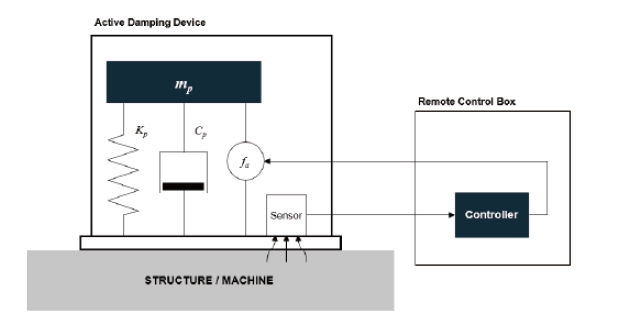
Due to the inertia actuator, there is no need for external mechanical connections, just like the classic damper shown in Figure 1. Unlike classical dampers that require physical reference anchors, ADD has virtual reference points. It is' hooked on the sky '. Therefore, ADD can be installed on structural components that do not exist or are not actually connected to the ground, or even on moving parts.
※ Large working bandwidth
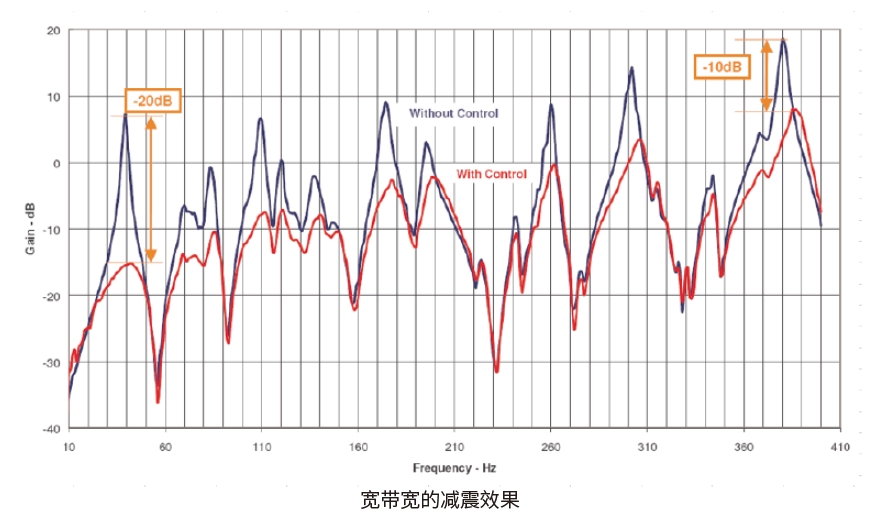
ADD will have a damping effect on the structures connected to it, which is monitored by sensors. Unlike 'tuned mass dampers', ADD can dampen multiple modes within its operating bandwidth (typically between 25-2000Hz). Even if there is structural variability, that is, when the position of the structural pattern changes due to some reason, or when the external disturbance source of the structure changes, this can still maintain efficiency. (For example, the vibration spectrum that varies with the speed range of an electric motor)
※ Compact
The performance of ADD is not driven by the mass ratio between the structure and the actuator, as is the case with tuned mass dampers. The size of the actuator depends only on the required control force, that is, the amount of vibration energy extracted from the structure. Impressive damping ratios have been achieved on a 400kg structure using a 20GR actuator. There is no need for external mechanical connections due to the inertia actuator, just like the classic damper shown in Figure 1. Unlike classical dampers that require physical reference anchors, ADD has virtual reference points. It is' hooked on the sky '. Therefore, ADD can be installed on structural components that do not exist or are not actually connected to the ground, or even on moving parts.


 Chinese
 English



 Top
Top